


Tire Checklist: Signs You Need New Tires
No matter what type of Subaru you rely on to hit the road, you’ll eventually need to replace your vehicle’s tires. Tires can wear down through many forms of impact and exposure. Below we’ll detail the signs of deterioration that indicate you need new tires on your wheels.
Vibration and Tire Wear
If the amount of ride vibration your Subaru vehicle gives you as you drive increases sharply, your vehicle’s tires are likely misaligned or unbalanced. Your shock-absorbent systems may also be beginning to fail. Whether the vibration’s source is rooted in your tires or not, this form of vibration exposure can significantly damage your tires over time.
If your Subaru vehicle sways along with the vibration, you could have a more severe issue related to your vehicle’s rotors or axles. When you notice a substantial variance in your vehicle’s vibrations, head to our service center as quickly as you can. The professional staff members at Huffines Subaru Corinth are ready to care for all of your tire-related needs.
Check Your Tread Depth
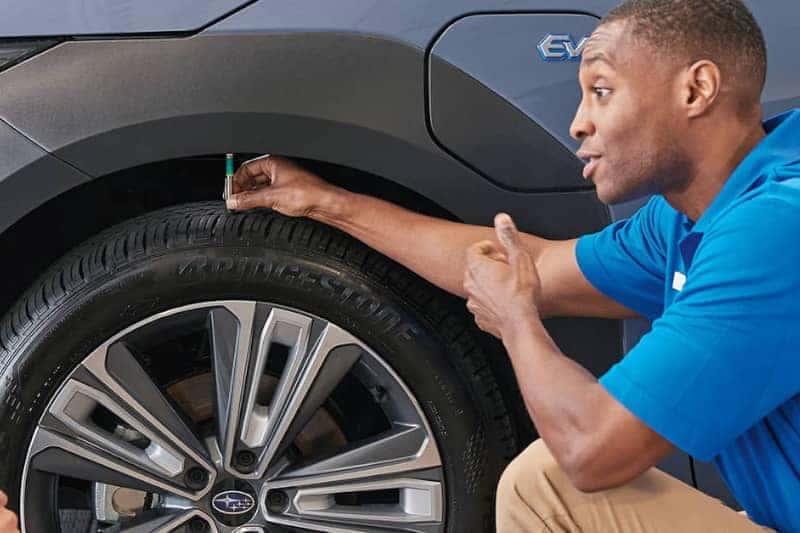
The treads are the most important surface on your wheels. The more they wear down, the less traction you have on the road. The less tire traction you have on the street, the more likely you will slide into an expensive collision. Never let your tires go below 1.6 millimeters or 1/16th of an inch in depth. SUV and pickup truck tires have deeper treads, so it takes longer for their tires to deteriorate.
That said, given the loads they haul, the newer the tire treads are, the better. New tire treads grant optimal road grip. You can use standard measuring equipment to find out where your vehicle’s tire treads stand, but you can take advantage of a simple trick to check your tire tread condition quickly. Take a Lincoln penny and set it into the cracks between the tire treads. Place the penny into the tread with Lincoln’s head down. If you can see most of Lincoln’s head, it is time to change your vehicle’s tires.
Checking Newer Tires
Newer tires feature an innovation that makes checking the tire tread level easier. Treadwear indicator bars are barely visible when your Subaru tires are new or nearly new, becoming more and more visible as the treads wear down. They are generally rubber bars that run perpendicularly to the treads. If you can clearly see these indicator bars on your vehicle’s tires, make sure you replace your tires soon.
Sidewall Damage
The sidewalls are the portions of the tires that do not touch the road. Sidewalls carry identifying information, including wheel and tire measurements, brand, part number, and type. Breaks, cracks, or cuts that form in your tires’ sidewalls can lead to dangerous accidents if you don’t replace the tires quickly.
Minor sidewall issues can cause leaks, while severe sidewall deterioration can lead to explosive decompression while driving. Explosive tire decompression is a leading cause of wrecks and driving-related injuries, so check your tire sidewalls regularly.
Blisters, Bulges, and Surface Blowouts
Blisters and bulges in your vehicle’s tire treads or sidewalls indicate that your vehicle’s tires have lost their internal structural integrity. Slight swelling may seem like a problem that you can wait to fix, but it can shift into being a large and dangerous concern without warning.
A tire blowout like this one can be hazardous to you and nearby pedestrians alike. This form of blowout commonly sends rubber shards flying. If you see a bulge or blister on any part of your tires, take them in and have service professionals change the tires immediately.
Keep Your Tire Warranty in Mind
Responsible drivers ensure that applicable warranties cover their Subaru vehicle and its parts. Coverage is usually available for up to seven years for Subaru tires. This coverage includes flat tire repair, mounting and balancing, and replacing your vehicle’s tires in the event of damage by road hazards. If your Subaru tire warranty is about to run out, it is probably time to order new tires.
Every tire and wheel warranty program comes with emergency roadside assistance perks. These benefits include towing, jump starts, flat tire replacement, fluid delivery, and lockout assistance. As you can see, you’ll gain much by ensuring Subaru’s warranties cover your tires.
The Importance of Uniform Tire Sets
When it comes to changing your tires, you may think you can replace one or more tires with a version from another company. Subaru tires work best alongside other Subaru tires, and variations in tread patterns and durability can cause issues down the road.
Avoid using tires of different sizes in the front and rear of your vehicle. Different tire sizes can cause dangerous traction levels and unforeseen system issues, leading to expensive vehicle damage. If you have Subaru performance tires, make sure you replace them either with a new performance set or an identical one. These tires feature distinct formulations to maximize agility, speed, cornering, and performance in different ways. Two half sets will reduce these gains.
Changing Single Tires Versus Changing the Set
With many vehicles, especially those with heavy tow and workloads, it is not uncommon for one or two tires to wear out before the others. You may think you can replace only the most worn-down tires, but uneven tread levels between tires can cause performance and safety issues. If three of your tires show signs of partial wear, and one is heavily worn, replace the entire set.
If you have a two-wheel-drive system and your drive wheels are more worn than your other two to a significant degree, you may have to replace these two tires and leave the others. Check with our Huffines Subaru Corinth service professionals to be sure. Getting new tires is a wise idea if you are beginning a major project or taking a particularly long work trip.
We at Huffines Subaru Corinth in Corinth, Texas, are dedicated to ensuring the safety of our customers through highly skilled and focused repair and replacement work. When the time comes to replace your tires, we want you to bring your Subaru vehicle to us for unparalleled service and attention to your needs.
0 comment(s) so far on Tire Checklist: Signs You Need New Tires